Is Currensea the answer to debit card users?

If you’ve seen the Hilton Honors Plus Debit Card, you’ve seen Currensea. It’s the company that issues it, and it makes similar cards for Marriott Bonvoy, United MileagePlus, Lufthansa Group Miles & More and American Airlines AAdvantage. It isn’t a bank, and the card isn’t a credit card.
As at 1 November 2026. Fees and terms change, so check Currensea’s site before signing up.
Why does Currensea exist?
Currensea is a UK fintech company launched in 2020 that started by letting people spend abroad without their bank's foreign exchange fees. You link it to your existing current account, spend on the Currensea card, and avoid the charge your own bank would add. If your bank charges for foreign spending, that can save you money. If your bank already charges nothing, the saving is smaller or absent, so check your own terms.
The points cards are a newer use of the same idea. Most card payments in the UK are on debit. According to UK Finance, debit cards were used for 54% of all payments made in the UK in 2025: 26.6 billion payments, against 5.3 billion on credit, charge and purchasing cards. Counting card payments only, that is roughly 83% on debit, by our calculation. Yet points cards have mostly been credit cards.
Currensea argues that regulation is part of the reason. Fees that retailers pay on card payments have been capped since December 2015, on average at 0.2% for debit and 0.3% for credit, which it says leaves credit card issuers with less to fund rewards. It also says people rarely switch banks, so a debit rewards card works best if it links to the account you already have. That is Currensea’s own view, and it doesn’t say who funds the points on its cards.
For a brand such as Hilton, the card puts more of your everyday spending on its card. For you, it can mean points without borrowing, without opening a new account, and, depending on your bank, cheaper spending abroad.
Plenty of people avoid credit, or don’t want another application on their credit file. Currensea lets a brand such as Hilton offer a rewards card without that. The card links to the bank account you already have, so there’s no new account to open or money to move.
How it works
- You pay with the card.
- Currensea pays the merchant.
- Currensea collects what you spent, plus any fee, from your bank account by Direct Debit.
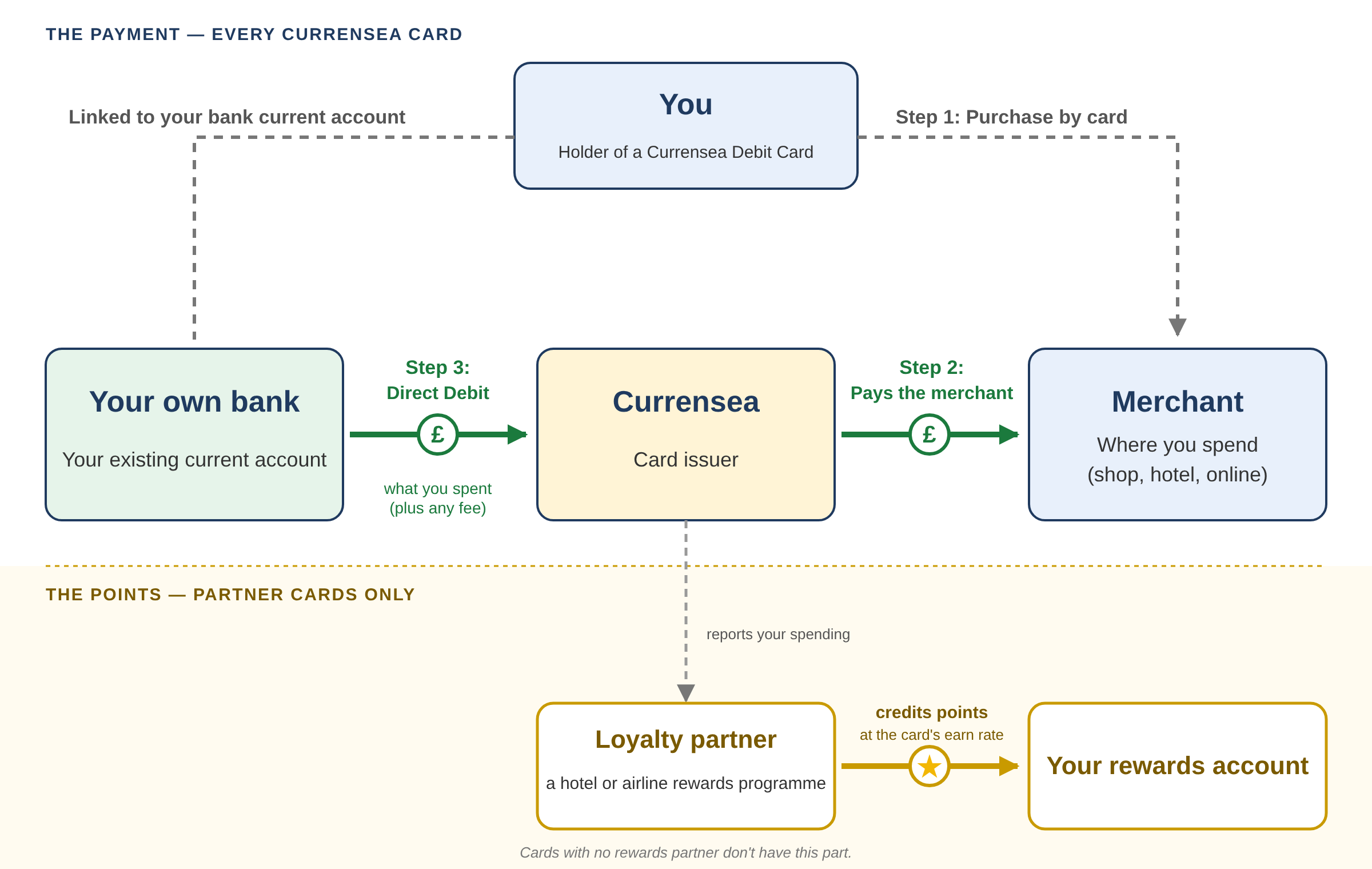
You don’t open a new account or top up a balance. You link your existing account in Currensea’s app. The card is not intended for borrowing, so keep enough in your account to cover what you spend.
On partner cards, each purchase earns loyalty points based on the amount you spend and the card’s earn rate. The points go into your rewards account. The rate differs from card to card.
Who can get it
Currensea’s eligibility page says you must:
- be 18 or over
- have a valid mobile number
- have an active current account with a UK bank it supports
- be registered for online or mobile banking
- be suitable for a payment card that uses a Direct Debit
- live in the UK or one of the other listed countries
It also says it may run extra identity checks and, if needed, a soft credit check.
Debit versus credit: what you give up
| Credit card | Currensea debit card | |
|---|---|---|
| Borrowing | Yes, interest-free period possible | No, it’s your own money |
| Application | Hard credit search | Possible soft check |
| Purchase protection | Section 75 on eligible purchases | Chargeback |
| If you can’t pay | Interest and a mark on your file | Card blocked, late fees, and unpaid amounts can go to collectors |
Section 75 is a legal protection on eligible credit card purchases. Chargeback is a card-scheme process, not a legal right, so the two aren’t equivalent.
What it costs
Each Currensea card has its own fees. Partner cards typically carry an annual fee, and most cards apply an FX fee abroad. The own-brand card has three plans with different costs. Check the current terms of the card you’re considering before you apply.
Do you need a partner card?
Currensea also sells its own card with no brand attached. It’s aimed at saving on foreign exchange abroad rather than earning points, and its plans have their own fees and limits. If you want Hilton Honors points, you need the Hilton card. If you only want cheaper spending abroad, the standard card may fit better. Check the current terms for each.
What’s in it for travellers
A partner card like the Hilton Honors Plus does two things at once: points on everyday spending at home, and cheaper spending abroad than most high-street debit cards. For someone who already stays at Hilton and keeps a steady balance, that can add up to real value for money you’d spend anyway. If you don’t collect Hilton points, the annual fee is harder to justify, even if the FX saving is useful.
Pros and cons
Pros
- Earn hotel points or airline miles on your everyday spending without a credit card
- Links to the bank account you already have — no new account to open or balance to top up
- No hard credit search on your file, only a possible soft check
- Potentially cheaper spending abroad, depending on what your current bank charges
- Issued by Currensea Limited, authorised by the FCA as a payment institution and a Principal Member of Mastercard
Cons
- No Section 75 protection on purchases, only Mastercard chargeback
- A failed Direct Debit blocks the card until you repay, and late fees apply
- The card can’t be used for ATM withdrawals in your home country
- Any annual fee has to be earned back in points or FX savings
- Only works if your bank is on Currensea’s supported list
Verdict
Currensea’s model may well be the answer for debit card users and fills a genuine gap in the UK rewards market. Until recently, earning hotel points or airline miles on everyday spending in the UK meant having a credit card. Currensea has opened that door to debit, so people who don’t want to borrow, or don’t want another hard credit search on their file, can still earn travel rewards.